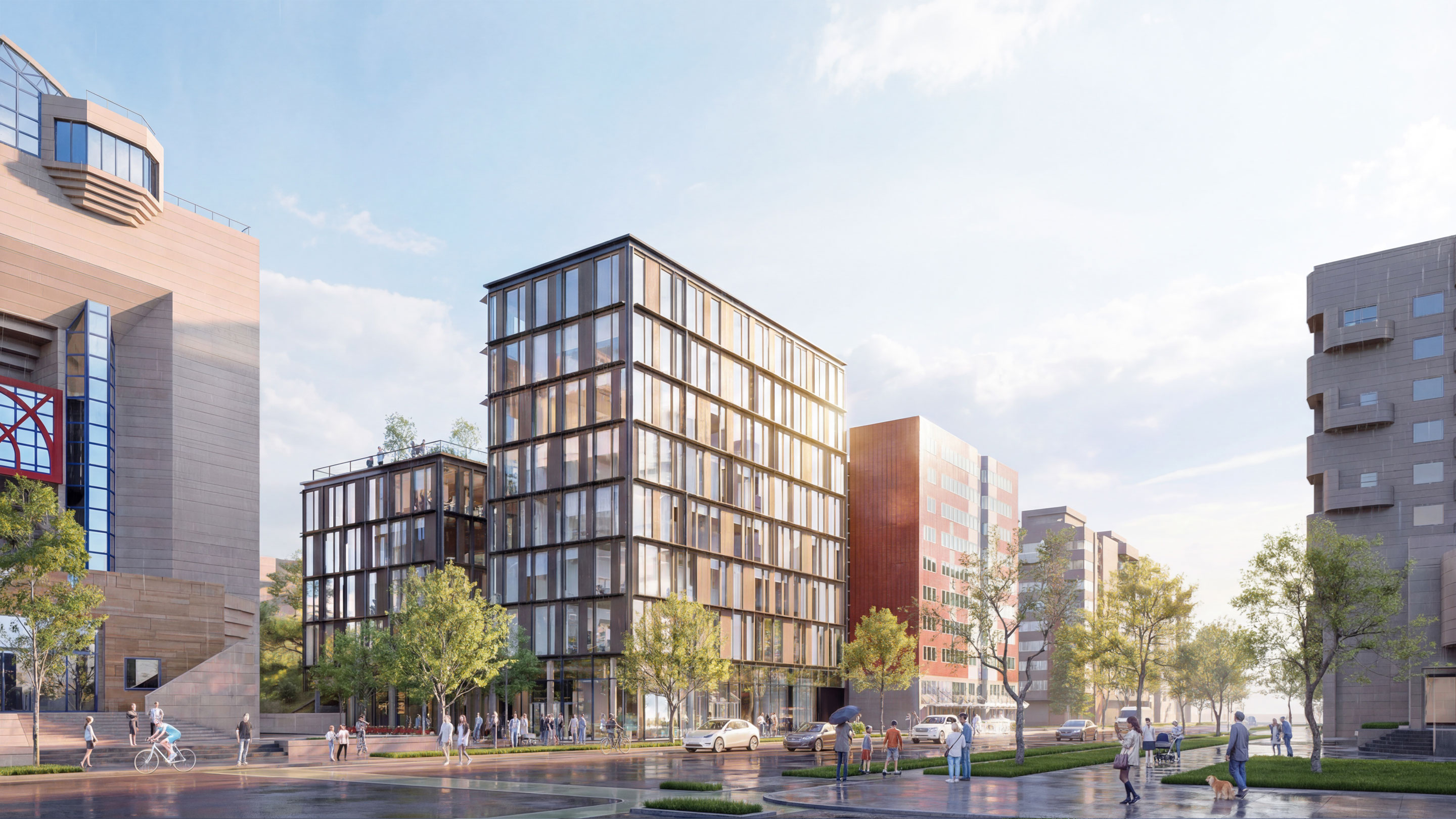
The ADRNV Headquarters is conceived as a regenerative building. Through energy efficient design strategies like integrated photovoltaics and flexible spatial organization, the project reduces operational demand while generating renewable energy and supporting long-term adaptability. More than an administrative office, it acts as a responsible urban prototype — producing energy, activating public space, and contributing positively to its surrounding neighborhood.
Client
Date
February 18, 2026
Team
Horatiu Racasan, Alexandru Dan, Paul Stroia, Cezar Cîmpeanu, Andrei Gavril Șimon, Monica Elisei, | Structural engineering: Cătălin Moga- Struktoplan, HVAC - Florin Popa Nicolae | Alexandra Urcan – management
Share on
The project creates a healthy, daylight-oriented working environment that prioritizes human comfort and spatial clarity. Offices are organized to maximize natural light, cross-ventilation, and visual connection to exterior terraces and planted roof areas. These outdoor extensions act not only as social spaces but as ecological layers — reconnecting the workplace with seasonal change, vegetation, and fresh air.
The ground floor operates as an open civic interface, dissolving the threshold between institution and city. Public functions such as the café and multifunctional hall reinforce pedestrian continuity and embed the building within everyday urban life.
Energy performance is not treated as an add-on but as a spatial and architectural driver.
The roof integrates photovoltaic panels positioned to optimize solar exposure. On southern façades, integrated solar control systems and photovoltaic surfaces regulate heat gain while producing renewable energy. The building envelope combines high-performance insulated panels with ventilated façade systems to reduce thermal loss and overheating.
Energy is stored and managed through heat pump systems and buffer storage, supporting reduced operational demand and long-term efficiency. Estimated annual renewable production significantly offsets consumption, positioning the building toward a low-carbon operational model.
The structural strategy balances robustness with material efficiency. A hybrid system reduces structural mass while maintaining durability and flexibility for future adaptation. Exposed and rationalized technical systems minimize material excess and allow maintenance transparency.
Flexibility is embedded into the floor plates, ensuring long-term usability and reducing the likelihood of premature demolition or functional obsolescence — a key principle of regenerative architecture.